
Ending a GamStop term lawfully
A solicitor-reviewed legal analysis of the contractual basis of the multi-operator self-exclusion scheme, the treatment the scheme has received in Commission licence-review proceedings and in ombudsman decisions, the position under the Consumer Rights Act 2015 and the Consumer Contracts Regulations 2013, and the legal status of the twenty-four-hour cool-off and the seven-year automatic continuation.
The purpose of this page, and what it will not do
This page sets out, from a strictly legal perspective, how a registration on the multi-operator self-exclusion register known as GamStop can be brought to an end. It is the longest page on the site by design, because the position is misunderstood more often than any other topic covered here and because the misunderstanding is exploited commercially by a small number of purported removal services that operate on the edge of the criminal law.
The paragraphs below therefore proceed at a slower pace than the equivalent material elsewhere on the site, and each substantive claim is anchored either to the scheme's own published terms, to the Licence Conditions and Codes of Practice or to a section of primary legislation.
The page treats the scheme as a lawyer would treat any voluntary consumer scheme with regulatory anchors: it identifies the contract, it identifies the parties, it identifies the terms and it identifies the routes by which the contract can be brought to an end. It also identifies, without ambiguity, the routes that do not work, the routes that are dishonest and the routes that are protected by design because harm-reduction schemes are of no value if they can be dismantled at the moment they are most needed.
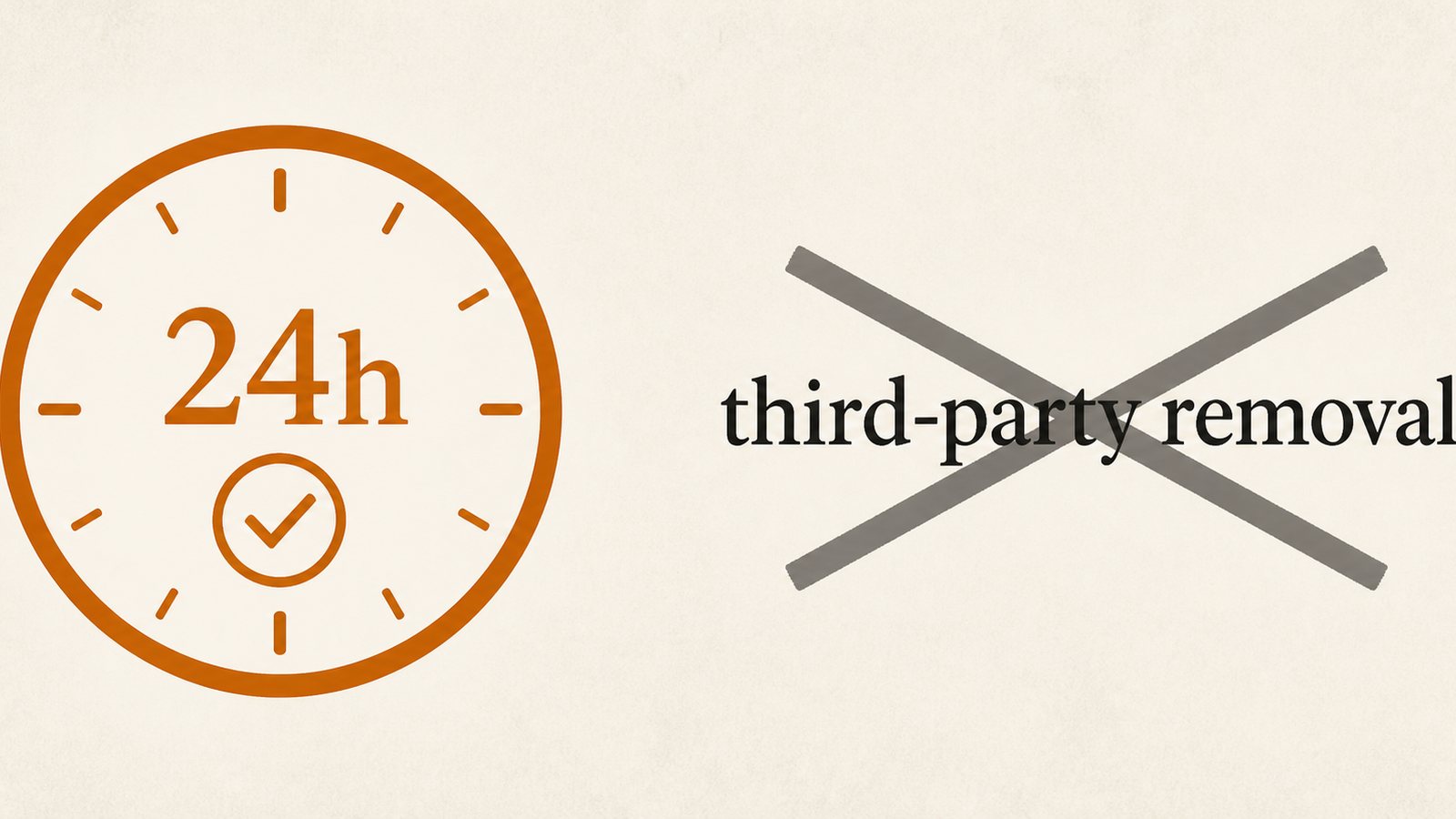
This page does not tell any reader how to defeat the scheme, because the scheme cannot be defeated within its minimum period and no lawful writing could pretend otherwise. It does not link to any third-party removal service, because those services are, at best, ineffective and, at worst, fraudulent.
It does not treat the registrant as a customer whose satisfaction is to be maximised at the cost of her own protection. It treats her as an adult who chose the scheme as a considered protective measure at some earlier date, and who is entitled to a plain account of what she agreed to, what she can lawfully do about it now, and what routes into help she can take before any decision to end the registration. Nothing on this page is an inducement to gamble, and nothing on this page presents cancellation as an achievement.
02The official route, a personal act no one may perform for you
The National Online Self-Exclusion Scheme Limited, incorporated at Companies House under company number 08807640, operates the scheme known as GamStop and publishes its terms and conditions at gamstop.co.uk. Those terms constitute the contract between the registrant and the scheme. The contract is entered into when a registrant completes the online registration form, provides the required identifying data (name, date of birth, residential address, postcode, email address and mobile number) and selects one of the three registration periods: six months, one year or five years.
Once the registration is confirmed by the scheme, the contract is in force and the terms apply. Removal from the register is a contractual act with defined preconditions, undertaken by the scheme on receipt of a compliant request from the registrant herself, authenticated against the identifying data on record.
The identity-verification step is not a bureaucratic formality; it is a structural feature that protects the registrant against a third party opening or closing a registration in her name. The scheme's terms require the registrant to log in at gamstop.co.uk using the credentials associated with her original registration and to satisfy verification against the personal data on file.
Where the registrant has changed her mobile number, her email address or her residential address since registration, the scheme operates an identity-recovery process that requires proof of the same identity through documentary evidence of the change (typically a bank statement or utility bill in the new address, together with confirmation of the change from the original registration email).
No third party can perform this step on the registrant's behalf, because the credentials belong to the registrant and the recovery process is designed to defeat impersonation.
A worked example
Consider a registrant who took a one-year registration on 6 September 2025 and who wishes to remove her registration in the ordinary course. She waits for the minimum period to expire on 6 September 2026, logs in to gamstop.co.uk on or after that date, verifies against her details of record, submits a compliant removal request in the terms the scheme sets out and waits the twenty-four-hour cool-off written into the scheme's own terms.
At the end of that cool-off, and only if she has taken no intervening step to withdraw her request, the registration is removed from the register and licensed operators are notified through the daily reconciliation feed. Any attempt to access a licensed remote gambling site before that removal is complete will be blocked by the operator's own check against the register.
03The minimum-term rule and why it cannot be abridged
The minimum period rule is the substantive protective feature of the scheme and, from a legal perspective, it is the term of the contract with the most careful design. When a registrant selects six months, one year or five years at the point of registration, she is making a considered election, in her own words and in her own time, as to the duration of a self-imposed restriction on her own behaviour.
The scheme's terms provide, in plain language, that once the registration is active the minimum period cannot be shortened. That is a matter of contract, and it is also a matter of protective purpose. The Commission's supervisory position, expressed in the Licence Conditions and Codes of Practice at LCCP 3.5.5 and in successor guidance issued under section 24 of the Gambling Act 2005, is that a subscribing licensee must enforce a live registration for its full period against the registrant, regardless of any subsequent communication from the registrant to the licensee purporting to lift the registration.
An argument that the minimum period is an unfair contract term, on the basis of section 62 of the Consumer Rights Act 2015, does not survive first-instance scrutiny. Section 62(4) provides that a term is unfair if, contrary to the requirement of good faith, it causes a significant imbalance in the parties' rights and obligations under the contract to the detriment of the consumer.
The minimum period does not cause an imbalance in the ordinary sense; it is the substantive service the consumer contracted for, and the consumer received precisely that service. Section 64 further provides that the fairness test does not apply to a term that specifies the main subject matter of the contract, provided the term is transparent and prominent.
The minimum period is the main subject matter of the scheme and it is transparent and prominent on the face of the registration flow. The result, on any lawyerly reading, is that the term is not vulnerable under the 2015 Act. A parallel argument that the term is a penalty within the classical Dunlop line of authority (Dunlop Pneumatic Tyre Co Ltd v New Garage and Motor Co Ltd [1915] AC 79, refined in Cavendish Square Holding BV v Talal El Makdessi [2015] UKSC 67) also fails, because the scheme's minimum period is not a secondary obligation triggered by breach; it is the primary substantive obligation the parties have agreed. The penalty doctrine does not engage.
04The 24-hour cool-off that follows the term's expiry
The twenty-four-hour cool-off is a contractual term of the scheme, in force from the moment the registrant actively initiates a removal request at the end of her minimum period. The clock starts on the submission of a compliant, authenticated request through the login on gamstop.co.uk; it does not start on the expiry of the minimum period itself.
That distinction matters. A registrant who does nothing at expiry does not enter the cool-off. She enters the automatic continuation described in section five below. The cool-off is therefore not an interval that runs quietly in the background between the last day of the minimum period and the first day of unblocked access; it is a positive design feature that requires the registrant to make a further, deliberate act at a moment removed in time from the original registration decision.
The legal status of the cool-off is straightforward. It is not derived from the fourteen-day cooling-off period in the Consumer Contracts (Information, Cancellation and Additional Charges) Regulations 2013, which apply to distance contracts for the supply of goods or services entered into by a consumer in the ordinary sense and which do not fit the shape of a self-exclusion contract entered into for the purpose of harm prevention.
It is not derived from section 66 of the Consumer Credit Act 1974, which governs a different subject matter. It is a bespoke contractual protection, published in the scheme's own terms, tested against the evidence base for the durability of self-exclusion as a harm-reduction measure and endorsed by the clinicians who advise the scheme.
Its purpose is to provide a moment of reflection between the impulse to remove and the effect of removal, in the population most likely to benefit from that moment. Where the registrant changes her mind during the twenty-four hours she can withdraw the removal request through the same login, and the registration continues in force without interruption; no fresh registration is required.
Points worth knowing
- The minimum period is a substantive contract term, not a fee waiver or a service option; the Consumer Rights Act 2015 does not open a route to shorten it
- The twenty-four-hour cool-off starts on the submission of a compliant removal request, not on the expiry of the minimum period
- Automatic continuation for a further seven years applies where the registrant takes no action at the end of the minimum period, and is a protective default anchored in the clinical evidence base
The seven-year extension that applies on inaction
The automatic continuation is the second protective default written into the scheme's terms and, from a legal-analysis perspective, it is the most striking feature of the design. The scheme does not lift a registration by operation of time; it lifts a registration by operation of an authenticated request from the registrant.
Where the minimum period has expired and the registrant has taken no action, the scheme continues the registration for a further seven years. The seven-year default was chosen on the recommendation of the clinicians who advise the scheme and it reflects a substantial body of evidence that the longer-durability of a self-exclusion produces better long-term outcomes in the population that has already chosen to self-exclude.
It is not a punitive extension; it is a considered default, and the registrant retains the ability to end the extension at any time by taking the same compliant action she would have taken at the original expiry.
The scheme communicates the pending expiry to the registrant through the email address on record, in the weeks leading up to the end of the minimum period, and again shortly after the expiry date. Where the registrant has changed her email address, the identity-recovery process treated in section two above provides the route to update the record and to receive the communications.
A registrant who has moved through a period of stability during the minimum period and who wishes to reflect further before removal is entitled to let the automatic continuation run; a registrant who has actively decided that the protection is no longer required is entitled to take the removal step at the end of the minimum period. The choice is hers; the default protects the population as a whole.
A worked example
Consider the same registrant from section two above. She took a one-year registration on 6 September 2025. On 6 September 2026 she is in a period of stability and, on the advice of her GP and her financial counsellor, decides not to take any action.
She receives a further email from the scheme confirming that the registration has continued for a further seven years, and she keeps the confirmation for her records. In April 2028 her circumstances have changed materially and she wishes to remove the registration in the ordinary course.
She logs in at gamstop.co.uk, verifies her identity, submits a compliant removal request, waits the twenty-four-hour cool-off and is removed from the register. The route is the same at any point during the seven-year continuation as at the original expiry.
06Third-party removal services and why they carry no effect
A small number of purported removal services advertise, in various forms, the promise that they can shorten or defeat a live GamStop registration. From a legal perspective the claims fall into three categories, none of which reflects a lawful and effective service. The first category is the claim to remove the registrant's identifying data from the scheme's own database.
This is not achievable by any third party, because the database is under the operational control of the National Online Self-Exclusion Scheme Limited and access is restricted to authenticated scheme personnel. The second category is the claim to alter the registrant's identifying data (change of name, alteration of date of birth, use of a different address) in a way that allows the registrant to open a new account with a licensed operator without hitting the register.
Any such alteration would be a false representation to the operator's own age-and-identity verification under LCCP 5.1.3 and, in an appropriate case, an offence under section 2 of the Fraud Act 2006.
The third category, and the most cynical, is the claim to introduce the registrant to a website that the promoter describes as a non-GamStop operator with a clean payment route. In the general run of cases the introduction is an affiliate relationship, the promoter is remunerated by the offshore operator and the payment route is subject to the very deposit friction described on the KYC and payments page linked below.
The registrant has paid a fee, has received no useful assistance, has assumed the full risk of transacting with an offshore operator, and has no route of recovery for the fee against the promoter absent a civil claim of doubtful value. Where the promoter has made specific representations that turn out to be false the payment may amount to a fraud within the meaning of section 2 of the Fraud Act 2006 and the appropriate reporting route is Action Fraud at actionfraud.police.uk, run by the City of London Police as the national reporting centre for fraud and cybercrime.
The Advertising Standards Authority has, in a series of adjudications through 2024 and 2025, upheld complaints against providers of purported removal services on grounds of misleading advertising under the Committee of Advertising Practice Code; adjudications are published on the ASA's own website and are a useful evidential resource where a consumer is contemplating a small-claims track recovery of a fee.
Harm-reduction measures for the interim period
Where a registrant is within her minimum period and finds the restriction more difficult to sit with than she anticipated at registration, the correct question is not how to shorten the registration but what to add underneath it. The scheme was never designed to be a single line of protection; it was designed to work alongside other tools that address different vectors of temptation.
Card-level gambling switches at HSBC, Monzo, Starling, Lloyds and Barclays are treated in detail on the KYC and payments page. Device-level blocking software (BetBlocker and GamBan are the two free tools funded through the charitable sector) closes the browser and app vector on the specific device on which they are installed.
Mobile network content bars offered by EE, O2, Three and Vodafone add a network-layer filter to gambling categories. Each of these tools takes minutes to enable and is subject to the same considered protective delays that the GamStop scheme applies to its own removal.
Where the concern is not the technical availability of gambling but the underlying urge to gamble, the routes into help set out in section eight below are the correct starting point. Talking to the National Gambling Helpline is free of charge, is confidential and does not commit the caller to anything beyond a conversation about what is happening.
A first appointment at an NHS specialist gambling clinic can be arranged by self-referral without a GP letter. A first session at a GamCare partner service (Adferiad in Wales, RCA Trust in Scotland, Gordon Moody residential in England) can be booked without cost. The professional literature is clear that the moment of greatest difficulty during a self-exclusion tends to be around the third to fifth month of the first registration; a conversation at that moment is meaningful.
The clinical literature also records that the addition of a device-level block during a period of urge is often more effective than any single conversation, because the block removes the mechanical availability of the behaviour and gives the underlying urge time to subside; the two interventions are complementary, and a helpline adviser will typically recommend both.
08Seeking help first, GamCare and NHS gambling clinics
Every decision to end a live self-exclusion is a decision the registrant is entitled to take at the end of her minimum period, and every such decision merits a conversation before it is made. The National Gambling Helpline on 0808 8020 133 is the single starting point recognised across the treatment sector, the regulator and the responsible-gambling charities.
The line is staffed twenty-four hours a day, every day of the year, by trained advisers employed by GamCare, the leading charity in the sector. A first call does not commit the caller to any further step; it is a conversation about what is happening now, about the reason for the current wish to end the registration and about what routes into help exist locally.
The line is anonymous unless the caller chooses to identify herself, and the record of the call is subject to GamCare's own data-protection framework under the UK GDPR and the Data Protection Act 2018.
Beyond the helpline the National Health Service commissions a network of specialist gambling clinics that accept self-referral without a GP letter. The National Problem Gambling Clinic operates in London under the Central and North West London NHS Foundation Trust. Regional clinics operate in Manchester, Sheffield, Leeds, Southampton and Stoke-on-Trent, together with the Northern Gambling Service that covers the north of England.
Funding for the network is provided through the Statutory Levy under the Gambling Levy Regulations 2025 (SI 2025/152), in force from 6 April 2025, under which the National Health Service receives fifty per cent of the levy yield for treatment. A first appointment is typically available within four weeks of self-referral, and a conversation with a specialist clinician is an entirely appropriate step to take before any removal request is submitted to the scheme.
Where the registrant is a person whose household includes debts arising from earlier gambling losses, a parallel conversation with a free debt-advice service (Citizens Advice, StepChange or PayPlan) is also worth having; the financial picture and the clinical picture inform one another and neither should be considered in isolation from the other before a decision to lift a live self-exclusion.
Read next
- What GamStop is and how it actually works
- Legality for UK players and where UKGC remit ends
- Consumer-protection risks of offshore sites
- KYC, AML and payment realities for UK players
- Help, support and where to talk to someone today
Sources and verification
Verified against the Gambling Act 2005 at legislation.gov.uk, the Consumer Rights Act 2015 at legislation.gov.uk, the Fraud Act 2006 at legislation.gov.uk, the Consumer Contracts (Information, Cancellation and Additional Charges) Regulations 2013 at legislation.gov.uk and the scheme's own published terms at gamstop.co.uk. Last checked 5 August 2026.
Frequently asked questions
Is GamStop a statutory scheme or a contractual scheme
It is a contractual scheme with a statutory anchor. GamStop is operated by the National Online Self-Exclusion Scheme Limited, and each licensed remote operator subscribes to the scheme in order to satisfy the Licence Conditions and Codes of Practice, in particular LCCP 3.5.5. The registrant enters a bilateral contract with the scheme; the licensee enters a contract with the scheme in parallel.
Has any English court looked at the GamStop scheme
The scheme has featured in Commission licence-review proceedings before the First-tier Tribunal (Gambling) and in ombudsman decisions of the Independent Betting Adjudication Service. It has not been the subject of a reported judgment of the High Court on the enforceability of the minimum period. The commercial basis of the scheme, and the consumer's position within it, remain matters of contract law read alongside the LCCP.
Can I rely on the Consumer Rights Act 2015 to shorten my registration
The Consumer Rights Act 2015 applies to consumer contracts including service contracts, but section 62 of the Act tests fairness by reference to the balance of rights and obligations between the parties. A registration to a self-exclusion scheme, freely elected as a protective measure, is unlikely to be unfair merely because the registrant later wishes to shorten it. The minimum period is a substantive feature of the service, not an incidental term.
What is the legal status of the 24-hour cool-off after expiry
The 24-hour cool-off is a contractual term of the scheme, published in the scheme's own terms and made a condition of removal from the register. It is not derived from the fourteen-day cooling-off period in the Consumer Contracts (Information, Cancellation and Additional Charges) Regulations 2013, which does not apply to a scheme entered into for the purpose of harm prevention. It is a design choice with a clinical evidence base.
Can a third-party service cancel my GamStop registration for me
No. The minimum period is not shortenable by any lawful means, and the scheme's identity verification requires the registrant herself to authenticate against the details on the original registration. A third-party service that promises to shorten the minimum period is either ineffective or actively dishonest.
Any payment made to such a service is at risk and, in some cases, may amount to a fraud reportable to Action Fraud.
Talk to someone today
The National Gambling Helpline is free, confidential, and open 24 hours a day, seven days a week.